This is a meditation on oracles in three parts, working through the design research and decisions that I made while designing an oracle deck for Super Dead.
-
The first part of this essay focuses on what I call essential techniques: dice, Tarot decks, and playing cards.
-
The second part focuses on dedicated and designed oracles.
-
And the third part focuses on what I took from those types of oracles, and what I decided to include in the Super Dead oracle.
If you're only interested in one of those, I won't begrudge you for skipping ahead. In full, we're looking at about 5,000 words or a 15-25m read, but it's worth it if you're considering adopting an oracle for your game, considering tools to use for solo-play, or designing an oracle for either solo or collaborative play.
Why fuss about oracles anyways?
A goal I often have when running a game is to consistently simulate the fictional world the game is taking place in. I also challenge my players to take the reigns: not only to be active participants in the game, but to play their characters hard and push the action; to have their own agenda; to want things and try to go get them.
I don't promise my players that they can get those things, but I promise them they can try. And together, we find out what happens. The fictional world is not unlike our own: you don't always get what you want. And tabletop games are not wholly unlike other games: sometimes you win, sometimes you lose.
But when you challenge your players to have goals, to see those goals out, and to trust you to play the world wherever the game takes them you're setting yourself up for a challenge. No gamemaster can know every detail in advance.

One response to that is "So what? Just make it up when you get there." But that itself poses two problems. First, there's the problem of coming up with every minor detail. This can be improvised, but doing so leaves little room for anything else. The instinct then becomes to take away player agency simply out of self preservation.
But we want more agentic players, not less. And as gamemaster, our players want us to play our NPCs hard and smart. This is especially true for "The Threats". A victory is all the more sweet if it was earned. As the Joker is oft to remind Batman: heroes and villains need each other. If we're using all our mental bandwidth keeping up with the players, we can't strategize for our villains. This takes something away from the players and the game as a whole.
But the second problem is actually bigger than that. The second problem actually undermines the fabric of the game itself. If we are constantly making things up – even if we are using our best attempts to simulate the world – we are moved as the gamemaster from the stance of the characters in the game world to the stance of an author, placing things in the scenes. And that's not where I like to be as a gamemaster.
I save author stance for prep; for adventure writing; for designing compelling locations so not every fight happens in the sewers below town or the forgotten tomb outside of it; for coming up with interesting new monsters; for analyzing who the player characters are and attacking their morales, their convictions, and their relationships – not just their character sheets.
But at the table, I want to play my characters.
That's what oracles do. They answer questions for us so we can stay in character.

The Essential Techniques
Oracles are a kind of lazy prep that strives to encompass generic situations. Where a roll table attempts to resolve an individual situation – classically: what comes and finds me in this dungeon if I stay in one spot for too long? – an oracle aims to resolve a near infinite number of situations.
In this section, I address the three essential oracle techniques that must be discussed as a baseline for generic situation resolution:
- The 1d6 Method
- The Tarot Deck
- The Playing Card Method
These methods are essential in so far as they are (1) complete oracles, (2) readily accessible, (3) come with long traditions in the hobby or beyond. This makes them a natural fit in tabletop games
The 1d6 Method
The first of these approaches is what I'll call the 1d6 Method – although as far as I'm aware, no one else calls it that. The 1d6 Method works as follows. Have you been asked a question where you don't know the answer? Roll 1d6. If you rolled low, the answer is no; if you rolled high, the answer is yes.
The method is crude, but it is effective, fast, has a lot of the same feel as rolling on a random table – it can even pass for as much if that's important to you. More than anything, the 1d6 Method gets the job done.
There is an "advanced" variant of this that adds degrees of success. In this advanced variant, 1-3 are still "no" and 4-6 are still "yes", but the results 1 and 6 are exaggerated with "and" (e.g., "no, and...") and the 3 and 4 are moderated with "but" (e.g., "yes, but..."). This variation is good for people that value those partial success / partial failure states, and want to apply it to their oracle.
For my taste, the added complexity doesn't add much and this is not the type of help I'm looking for. The "And" and "But" brings me back to where I started – asking questions instead of seeing what is happening.
There's a third and final version that I like a bit more than either of the first two. Let's call it, "The Simulationist 1d6 Oracle". Using your knowledge about the world and the player characters, you assign a likelihood that the answer is yes on a scale of: not likely, 50/50, or pretty likely. If it's not likely, the answer is only "yes" on a 5 or 6. If the answer is pretty likely, it's only "no" on a 1 or 2. If I was to use any of these, this would probably be my go to; it feels like rolling on an infinite, simple random table in your head.
Comparison of 1d6 Method results
| 1d6 | Plain | But/And | Low | 50/50 | High |
|---|---|---|---|
| 1 | No | No, and... | No | No | No |
| 2 | No | No | No | No | No |
| 3 | No | No, but... | No | No | Yes |
| 4 | Yes | Yes, but... | No | Yes | Yes |
| 5 | Yes | Yes | Yes | Yes | Yes |
| 6 | Yes | Yes, and... | Yes | Yes | Yes |
The Tarot Deck
In contrast to the 1d6 Method, which only answers closed questions, the Tarot Deck excels at vibes. The process is deceptively simple: whenever your players encounter something in the world where you don't have prep, you flip a Tarot card, interpret the result, and narrate a response that is consistent with both the fictional game world and the Tarot card.
Something I particularly appreciate about the Tarot approach is that with some anticipation you can flip cards ahead of the scene itself. This is like rolling the random tables provided by an adventure writer, to turn 1d6 skeletons into 3 skeletons. It takes our lazy prep and makes it function like eager prep. We can give hints, clues, and foreshadowing against in like we would more established prep.
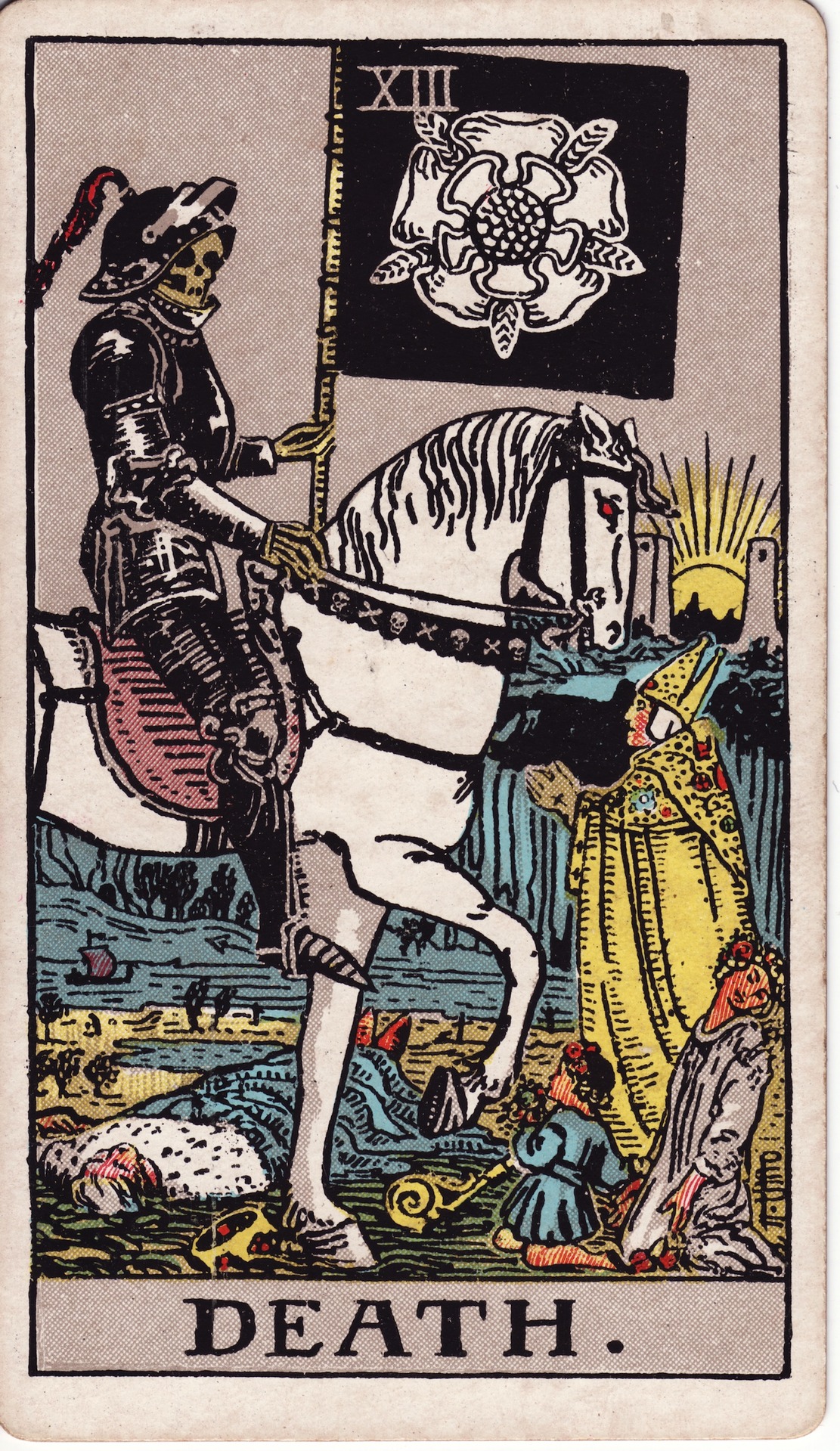
In the same breath, for much the same reason that you want to roll your dice in plain view, it is also advisable to draw Tarot cards in plain view. If you draw the card "Death" and a player character ends up dying in the scene, the players will enjoy knowing that the outcome was part of the game – and not a capricious whim of the gamemaster.
The Tarot Deck, for its part, is a 78-card pack of cards, each with a large picture on it. The cards are split between major arcana and minor arcana, and the minor arcana are further split into four suits. If you are unfamiliar with Tarot and only wish to conceive of it as a deck of playing cards with big pictures and an additional 26 cards you would only be a little wrong.
Modern Tarot is primarily used for cartomancy (that is: for Tarot readings) where a reader will gather your energy, have you ask a question, lay cards out on the table, and then read the answer in the cards.
In these readings, each of the cards has an established meaning. But it part of the art of the reader to assess the situation at hand, the context of the question, the context of the other cards, and interpret the "correct" reading of the card. This is identical to how a gamemaster uses Tarot cards at the table. The gamemaster interprets the card in the context of the situation, using the Tarot card as a guide.
Tarot cards offer an advantage over plain yes/no oracles because they are evocative and can help the gamemaster answer more complex questions.
Andy: "Who else is in this tavern?"
Gamemaster draws the Four of Cups
Gamemaster: There are four mourners, drinking quietly. They have obvious religious iconography about their attire, as if to court favor from their god.
The drawback, of course, is that they rarely provide an obvious "Yes" or "No". It is therefore helpful to have both approaches in our repertoire.
I'm a huge fan of using Tarot cards as an oracle. And while the classic Rider-Waite symbols are fine, I find the magic happens when you can get a deck that fits the flavor of your campaign. Both TarotArts.com and Etsy have a wide variety of Tarot decks, so whatever the nature of your campaign, if you're going to be running 5 or more sessions, it's probably a good investment.
I personally look for good use of color and multi-faceted, clear imagery. There is a definite trend towards monochromaticism and minimalism in cards. This dilutes the evocative power of the cards, which are intended to include symbols deeply and historically tied to Western mysticism. Cards that have too much imagery, likewise, become overburdened, muddy, and difficult to read quickly.
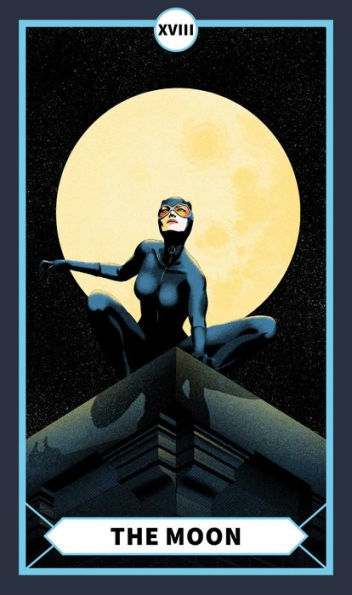
Thematically, for supers and zombies, the D.C. Comics Tarot actually does a good job of this. With the Catwoman card being a great example of something that has clear, evocative imagery and good color use. You've got a big moon, a reflection, a woman on watch, a rooftop. There's plenty going on – but it's also limited, so each of those elements is accessible quickly.
The one thing I will say, if you are on the lookout for thematic cards, is to beware of the growing amount of AI-illustrated Tarot decks. Because AI doesn't differentiate the symbolic language of the Tarot from the general purpose visual frequencies, you're likely to get AI-slop Tarot with an uneven inclusion of symbols throughout.
The Playing Card Method
The playing card method has many of the advantages of Tarot, with all the binary cleanliness of the 1d6 Method. To use this approach, take a standard deck of cards and draw a card whenever you are asked a question you don't know. Then use that card to answer the question.
For closed, yes/no-style questions, we can use the suits and numbers to answer questions. A simple way to do this is to assign one color to yes and one to no. Or, if you want to do more of a semi-simulationist approach, you can do 6+ if they have good odds, 8+ if they have even odds, and face cards only if they have bad odds.
For open-ended questions, we can use the cartomancy meaning to answer the question. Cartomancy works well; it's effectively a Tarot reading with just the minor arcana. There is, however, a higher burden of knowledge. Because you don't have the mystical symbolism drawn on the cards themselves, you're going to have to memorize or look up the Cartomancy meanings.
If you're considering using playing cards, I recommend keeping a small list of all the meanings in your prep, so that you have it on hand for when you invariably forget what the 8 of Clubs represents (greed or dissatisfaction with money).
Cartomancy Suits and Themes
| Suit | Theme |
|---|---|
| Hearts | Emotions, Family, Love |
| Diamonds | Wealth, Material Concerns |
| Clubs | Work, Ambition, Creativity |
| Spades | Challenges, Transformations, Endings |
Like Tarot cards, playing cards also come in many flavors. It's trivial to find superhero playing cards or zombie playing cards for less than $10. Most playing cards, however, only have that flavor on the face cards and card backs. This is in contrast to a Tarot deck that has vibes on ever card.
Most of all, what playing cards lack is connection to the game. Most TTRPGs do not use playing cards in their standard mechanics. Though there are some that do. I find when I use playing cards as an oracle, it takes some of my players out of the game because they don't understand what is happening. Dice are more accepted. And Tarot is more self-evident.
That said, there are entire oracle approaches based on just playing cards – so if you want something that is easy to bring to the table and can be expanded for near-infinite complexity, this approach is the one.
Dedicated Oracles
Having studied the essentials methods, we can turn our attention to specialized systems: dedicated oracles people have made for tabletop roleplaying games. For the most part these oracles are made for solo-play, which is not strictly our purpose, and there are some solo-play pitfalls we want to watch out for.
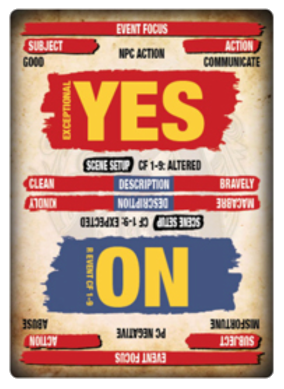
Namely solo-play can be a procedure heavy process with many, extended lookup tables; and, solo-play can be an author-dominant exercise. Either or both of these can be fine and fun. And they're both necessary for a type of solo-play, where you want to exercise a sort of chaotic improvisational muscle. But the sheer volume and depth of the tables can mean more rolling and lookups than actual play. Potentially fine for solo play, but detrimental to gamefeel and pacing at the table.
That all said, it's worthwhile to look at the solo-oracles because they were designed specifically for inspiration in tabletop gaming. The authors thought about what they were doing. We can launch ourselves off their shoulders, learning from both their successes and their mistakes. Even with the difference in focus – solo-play versus community play – there's no reason a priori to believe that this distinction is bigger than the distinction between genres (e.g., a superhero or horror game versus a fantasy game), between games within the same genre (e.g., Dungeon World and D&D3.5), or even between versions of the same game (e.g., ODD and D&D 4e).
What follows is an analysis in two parts: first, a descriptive review of what is included in various oracles; and second, my personal take on the mechanics – what I like and why.
What's in a Gamemaster Oracle?
For this analysis, I assembled a convenience sample of 9 gamemaster oracles from DriveThruRPG and Itch.io. I made an effort to include all the most popular and the most accessible oracles. There is not a huge amount of publicity around most of these products, so it's possible I missed something important.
- Mythic Game Master Emulator and Emulator Deck
- Game Master's Apprentice
- Tricube Tales Solo Rules and Deck
- SoloDark
- Juice Oracle
- Cepheus Solo Oracle
- The Solo RPG Toolkit
- One Page Solo Engine
- Runic Oracle
Descriptive Review
Across the 9 oracle designs I counted 16 distinct oracle features: answers, answers with modifiers, events, NPC inspiration, story/plot inspiration, action inspiration, scene difficulty, dice roll, symbols or icons, name support, location inspiration, a "vibe" word, mystery clues, items or treasure inspiration, monster inspiration, and trap inspiration.
Features included in GM Oracles
| Answers | Story / Plot | Symbols or Icons | Mystery/Clues |
| Answers with Modifier | Action | Names | Items or Treasure |
| Events | Difficulty | Locations | Monsters |
| NPC | Dice Roll | Vibe Word | Traps |
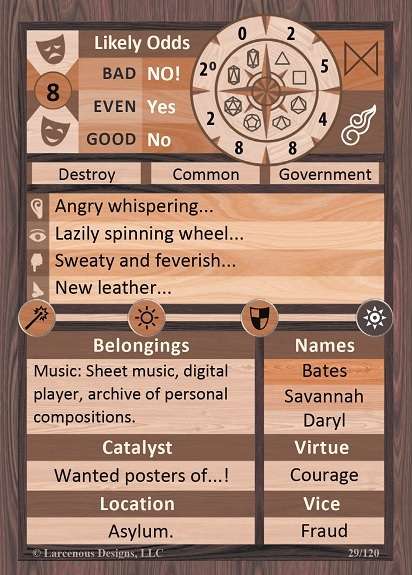
The most common of the features were: Yes/No question answering, vibe words, and NPC support. No oracle that I looked at lacked two of these most common features.
The modified style of Yes/No answering was popular, showing up in 7 oracles. I suspect that this is part of the fun of solo play – and getting another chance to look up a twist on the charts is enjoyable here, not a distraction.
Events, story or plot, and location inspiration all showed up in at least 6 of the oracles. Only the two most minimalist oracles lacked more than one of these features: the Cepheus Oracle and the Runic Oracle. This points to a clear need to answer the "what happens next" question, or the "where do we go from here" question.
Items, monsters, and traps were less popular, but showed up multiple times each. When they did show up, these features showed up as part of oracles that doubled as solo-game engines. This suggests that even solo-players aren't expecting to need this information on the fly that often. And that when they do show up, they're there specifically to create a particular game experience, i.e., this is a game about dodging traps, fighting monsters, and finding hot loot.
Difficulty ratings and dice rolls appeared in three oracles each, with three of the four card-based oracles having dice on them and two of the four having task difficulty. It makes sense to see dice results on the cards, because this allows you to directly engage with the game rules quickly, without finding and rolling dice. It reduces the overall loop time.
Lastly, NPC naming was supported by four of the nine oracles. It was a bit surprising to see this show up in under half of the oracles since naming NPCs is notoriously a problem for gamemasters. As we'll see in a second, though, all of my favorite gamemaster oracles had this feature.
Putting all this data through a quick similarity analysis, that Tricube Tales solo-rules and deck, the Juice Oracle, and The Solo RPG Toolkit are the most strongly related to one another. These are all full games, that happen to double as oracles. So that makes sense. Solodark, the One Page Solo Engine, and the Mythic Game Master Emulator form a second grouping. My guess here is that Solodark and One Page Solo Engine took inspiration from Mythic and added on a feature or two to be more setting specific, as Mythic came first and is more generic than the other two.
If we look at the spread of features across the oracles, the most common approach was to include between 8 and 12 features. Only two oracles were outside this range, one above and one below. Across all oracles, average number of features to include was 9, with an even spread on either side: four oracles above and five below this midpoint.
Personal Review
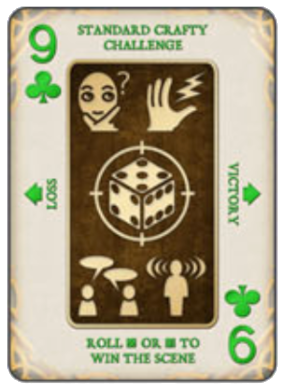
Looking at the oracles from a personal stance, my favorite oracle was either the Game Master's Apprentice or the Tricube Tales oracle and deck. These oracles were relatively fully featured, with both above average number of features. Tricube Tales was one of the few oracles to leave out question answering; they delegate that to a 1d6 die roll and show 1d6 outcomes on every card.
Both Tricube Tales and Game Master's Apprentice had the following eight features: NPC definition, vibe words, event inspiration, location inspiration, symbols, NPC names, difficulty ratings, and dice rolls. I find myself really appreciating the die roll, NPC names, and vibe words here. Die rolls give cards a lot of flexibility and support their use in coordination with other game mechanics. NPC names are a not-fun part of the game for me, so it's nice to have those outsourced. And vibe words provide a huge amount of versatility.
That the Tricube Tales cards double as playing cards is a nice touch. Including both that and the 1d6 outcome means we can create an endless amount of random tables to roll or flip on using these cards as well. With the Game Master's Apprentice, we don't need this as much because we get a roll on every standard die from 1d4 to 1d100. We've got a ton of numeric variation.
The one thing that Tricube Tales and Game Master's Apprentice don't do that I like from others – namely Juice, The Solo RPG Toolkit, and Solodark – is random monsters. A random threat is probably the most common use of random tables, e.g., the encounter table, the wandering monster table. Having something that injects danger into the game feels good. After all, setbacks and down swings are a core part of the narrative structure.
Overall, I think there's a lot to like here. One criticism I have is that I'm not sure every one of these oracles beats plain playing cards or Tarot cards – and that's kind of my default. I might use some of these rule systems for solo play. But I am probably just as likely to draw cards from a Tarot deck and interpret what happens next. Especially with some of the less featured and less specific systems.
In a lot of ways, that's what the One Page Solo Engine is. But I for my taste, things like the Mythic Game Master Emulator, Solodark, and Cepheus don't pass that threshold. And Juice, the Solo RPG Toolkit, and Mythic (again) feel too heavy for my personal taste.
Designing an Oracle
With all that in mind, let's design.
First, let's establish some of our design goals. I wanted my oracle for Super Dead to be evocative and fast; I wanted it to be part of the game; I wanted it to be something that felt like a mechanic, not something that felt like a cop out; and I wanted it to be clearly better than a Tarot deck.
I liked the information that Tricube Tales and Game Master's Apprentice provided. Those were my favorites, so I was starting with a list of eight things to strongly consider in my design: NPC inspiration, vibe words, event inspiration, location inspiration, symbols, names, a difficulty score, and dice rolls.
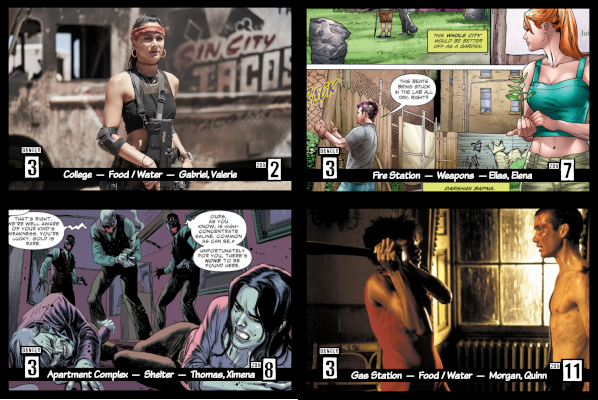
In the end, I decided on a card with only six features:
- A big, vibey picture
- Danger rating
- 2d6 roll
- Location
- Basic Need or Threat
- Names
Imagery
Choosing a picture as the central element was an obvious move, given my baseline. I had to be better than Tarot cards, so I figured I'd start with the Tarot feel and move from there. A big, symbolic picture is core to Tarot. So that's what I wanted to start with.
Every card in the Super Dead oracle has a large picture, drawn from zombie or superhero media: movies, TV shows, and comics. I picked images that captured something from the media that I'd also like to show up in the games I run.
Pictures are so vibey and thematic. Which is great. It reinforces the setting during play, and they can stand in for any number of different sources of inspiration.
The one drawback, if we want to consider it that, is that I am using a lot of copyrighted material for these cards. This means I can't really sell or distribute the deck in its current form. That was not a goal of mine, so it's not a problem. But in the future I might have artists redraw everything to make a commercially viable deck.
Numerals
The next two items I decided to include were a Danger rating and a 2d6 roll. Both difficulty and dice rolls were a part of my two favorite approaches, so I could have copied them over blindly, but I find they both reinforce my design goals as well.
Having a 2d6 roll on the cards allows a gamemaster to use the cards in lieu of dice, which integrates them more comprehensively with the game. The cards can also then be used for lookups on 2d6 tables. Because all of the gamemaster facing procedures are 2d6-based, this covers a ton of ground. In practice, the only thing a gamemaster needs to roll dice for would be the use of powers. And this supports the "Oh, what now?" feel that should accompany someone using their mutant powers. This is all the more true if they're a powerful villain of sorts.
The danger ratings are the triangular numbers from 0 to 21: 0, 1, 3, 6, 10, 15, and 21. In an explicit sense, they're intended to represent the number of zombies in an area when you're navigating to a new or unplanned location. In this way, it's like a specific roll table. I considered calling this "zombies" instead of danger, but because danger could come in many forms, I felt it better to leave it off.
The 2d6 can double as a Yes/No oracle as well, with 7+ is a yes for 50/50 situations, and 6+ or 8+ is a yes in likely or unlikely scenarios respectively. This is similar to how Tricube Tales includes the binary oracle on their cards and I think it's an elegant approach. The binary oracle is actually one of the ones I find myself needing the least.
Text
Lastly, there are three textual elements I decided to include on the cards:
- a location
- a basic need
- two names
The location and names were included as part of both the Tricube Tales and the Gamemaster's Apprentice, although only Gamemaster's Apprentice put it on their cards. The basic need is most similar to a Monster or Trap, from one of the full oracle systems – but it also has parallels to the sins in Gamemaster's Apprentice.
Location was part of 6 of the 9 oracles, so it was a strong contender from the start. One of the things I like about having location on the card is that it plays double duty. A location is not only a place, but it's also an inspirational word for all the things associated with that place. In this way, we get a lot of bang for our buck from a single word. Further, you find yourself needing locations a lot. So there's great economy here.
Names appeared on the fewest cards, but Game Master's Apprentice has them and so does Tricube Tales. I personally find it extremely useful to have a name cue. Even if I don't use that name, I might use a different name. For instance, I might not use "Zara", but I might use Amara, Aria, Zane, or Zayla. Having a starting point for a name is a lot better than nothing. So, two names per card: one that reads masculine to neutral and one feminine to neutral.
Lastly, the basic need was something that is specific to Super Dead. I included this because it serves a lot of purposes in the game. It's something you can attack as a consequence of a failure; it's something you can set as the objective of a question; it's something you can stock in a location. There's a lot of value here. And it's a good reminder that your basic needs are hard to meet in a zombie apocalypse. Super flavorful to keep it top of mind for the gamemaster.
Overall
Overall, I find the oracle deck accomplishes my major design goals. I ended up using only four of the sixteen features that I found on the oracles I reviewed, and relatively few of the most common. I omitted yes/no answers, explicit NPC description, and vibe words. In turn, I asked a lot of my features to work double duty. I expect that location and basic need are going to serve as vibe word, NPC description, event, story and plot, items and treasure; I expect 2d6 to be a dice roll, but also a yes/no oracle and an action.
Super Dead oracle features and objectives
| Feature | Design Goals |
|---|---|
| Image | Tarot baseline, evocative, fast |
| Danger Rating | thematic, part of the game |
| 2d6 Roll | mechanically integrated |
| Location | thematic, fast |
| Basic need | thematic, mechanically integrated, evocative, fast |
| Names | fast |
Further, I really expect the images to do a lot of work. I think this is a huge missed design space. Having evocative and symbolic images, a la tarot cards, really elevates the impact. You get a ton of variety and flavor, and you can consume it quickly.
One thing I didn't do was add playing card suits. I thought about it because of how much I liked what the Tricube Tales Oracle cards did – but eventually decided against it for a few reasons. First, I thought it would clutter the design space and distract the eye. And second, I didn't think I'd end up using that element much. I was never going to use them just to play cards, and a lot of that minimalist oracle design space was already solved for.

Probably the most different choice was the choice to go with a horizontal layout. Because I drew from comics, movies, and TV for imagery and a lot of those have a wide landscape perspective, I found I got a lot more mileage out of images if I went wide. If I end up having artists redraw the cards, I might go vertical instead and do something akin to a full-art magic card.
With a design like that, there would definitely be room to put a small playing card rank and suit in an upper corner – in addition to the other oracle elements.
I might also break out the 2d6 die roll into two 1d6 die rolls. A small change, but it adds to the meaningfully to the functionality of the cards – supporting other mechanics in the game.
Ultimately, really happy with how this turned out. I'm much happier using these cards than a generic oracle. And the price to have them printed (~$30) was only $10 more expensive than getting a deck someone else has put together, and cheaper than many small-print Tarot decks.
To compare to our benchmark, would I rather use this deck than a thematic Tarot deck or a deck of cards? Yes. Almost certainly.