Way late to the fight on this one, but I came across a blogging challenge that I wanted to join and figured that I was better late than never. After all, the challenge was compelling: take on a fight scene from media and provide a play-example of how the fight would resolve at your table, using your system.
In the author's words, the challenge has two parts:
- Pick a fight scene that isn't just two dudes hitting/shooting each other back and forth. Preferrably something with clever/weird manouvers and unconventional fighting techniques.
- Run as through how you would have adjudicated the fight, what kind of rulings would you have made to allow the players to pull off all the cool manouvers.
I think I'll approach this twice. Once with the original fight scene (here in LotFP) – to fully participate in the challenge. And then once using a zombie fight scene to highlight some of the specifics of Super Dead that only come into play with zombies.
Fight Scene #1: Guts versus the Knight Captain (Beserk)
Note: Read the fight summary, complete with screenshots, here
I wasn't fully able to follow the fight from just the screenshots provided, so I'm hoping not to butcher the details too much as I translate it into this fake play report. Here we go.
The player character Guts has been fighting knights in hand-to-hand, having been running from them. I'm going to rule that the sword is his only power; we'll put it at a rating of 4. I'll ask for a power-stunt to attack multiple knights in the same exchange. He rolls 4d6 for 3 successes and 12 damage, and then a 2d6 (7) to succeed and resist the stress from the stunt.
The 12 damage applied to four knights that charge him is plenty to take them out, with the armor reducing damage by 6 and there still being two wounds of damage left over. The remaining knights must make a morale check at 2d6. They get a 5 and fail the check. They're cowering in fear, having lost their will to fight.
Then, the Knight Captain shows up. The player can tell he too has a giant weapon: his a hammer (likewise, rating 4). The Knight Captain exchanges some words with with the player, before attacking: 4d6. The player takes a fully defensive action here – moving to doge the blow with his sword. I'm considering asking for a stunt, but this seems like typical sword play, so just a straight 4d6 roll there as well. The captain (NPC) gets 2 successes against the players 3, so no damage is dealt.
Then, the Knight Captain moves to attack. He's going to use a wild attack with his hammer, trying to damage everyone within range of him. He rolls 4d6 to hit and damage again. This time, three successes is good enough to split some of his allies' skulls with collateral damage – but again, not good enough to overcome Guts, the player character. Guts chose to defend again, getting 4 successes on 4d6 (2,3,3,6!4).
For the third melee exchange, the Knight Captain is going to try and smash Guts, our PC, one more time. Same roll: 4d6. Guts isn't having any more of this. He's going to power surge and attack the Knight Captain, so he'll roll 8d6. The Knight Captain rolls 2 successes and the player rolls 6, with 2 sixes exploding and juicing his total. The captain deals 5 damage. The player will take the hurt status, which will disappear as soon as he catches his breath. With 6 successes, our player is dealing 5d6 of damage to the captain. 18 damage rolled, minus 6 from the captains armor, is divided by 3 is four wounds. The Knight Captain soaks it all with his hammer.
As his Hammer power drops to zero, he's forced to make a Courage check to resist the stress. He fails, becomes cracked, and bows out of the fight.
Fight Review
This fight wasn't that interesting mechanically and our PC got the upper hand on the key roll. I originally thought that modelling these characters with just a single power wouldn't work – but it turned out to work just fine. I'm not sure I really got at what the challenge author wanted to represent. We don't have an "attack the weapon" action – but because the weapons are represented as powers, every attack can go against the weapon if the player chooses (and they always will, because otherwise you're taking it to the face.)
The other thing the challenge author was curious about was the massed combat at the front end. I think here, our power stunts do a good job modeling that.
Considering that the source material is manga – a type of comic – and we've tried to embed the comic book logic into our combat system (at least when it comes to using super powers), we've got something of an upper hand on traditional fantasy systems, which tend to take after medieval wargaming.
Fight Scene #2: Tallahassee vs Zombies (Zombieland)
For our bespoke fight scene, I'd like to look at the grocery store scene from Zombieland.
Woody: Tallahassee's stress relief is Twinkies, so we've got to stop at this grocery store, even if it means there are zombies inside. If I don't get that, I'm just a ticking time bomb.
Jesse: Alright, but Columbus is grabbing the shotgun. Not going to be caught in hand-to-hand with any zombies in there.
GM, in secret, makes a scavenge roll: 5. The Twinkies won't be there AND someone is waiting for them.
Woody: That's fine. Tallahassee wants 'em. I'll grab a banjo, a baseball bat, and some garden shears. And then walk into the grocery store and start playing the banjo.
GM: Okay, great. That's going to make some noise.
GM makes a noise roll in secret: 1d6 for 3; three zombies are on their way to the players.
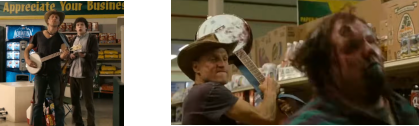
GM: A few seconds pass and a zombie comes out from around one of the shelves towards you.
Woody: I run up and smash it with the banjo.
GM: That'll be a hand-to-hand exchange. Since this is just a shambler, go ahead and make three attacks to see if you can take it out before it gets to attack you.
Woody Rolls 2d6 + Athletics (+2) three times, -1 for a head shot: 9, 10, 3. Then rolls damage twice: banjo is 1d6 (2, 6!, 3).
Woody: Two hits to the head, 11 damage.
GM: You wind up with your banjo and knock the zombie off its feet with the first strike. And then with the second, you bring your banjo down and smash its head. As you're doing that, another zombie comes out from around the corner, right behind Columbus. What does he do, Jesse?
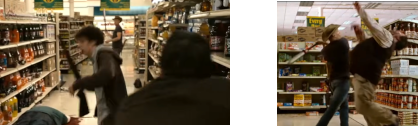
Jesse: Columbus runs towards Tallahassee, trying to get away from the zombie.
Woody: And then I'm going to ditch the banjo for baseball bat and take a swing at it!
GM: Alright. Athletics from Columbus to get away, and athletics from Tallahassee for the attack.
Jesse rolls Rolls 2d6+1 = 8+1 = 9* 9 for me; Woody rolls 2d6+2 = 6+2 = 8, 2d6 for 7 damage with the bat
Jesse: 9 for me. Woody: 8 to hit, 7 damage.
GM: 9 is going to be good enough for Columbus to get away, but you're going to take a consequence. Because of the adrenaline, any social checks you make are going to be at -1 until you calm down. As Columbus rushes past Tallahassee, Tallahassee rears back with a baseball bat and crashes it into the zombie. 8-1 for the headshot is going to be a hit and 7 damage is going to be enough to smash the skull of the zombie.
Woody: Awesome. Now that that's through, Tallahassee tosses the bat to the ground nonchalantly and head off to look for a Twinkie.
GM: You're scanning through the shelves, when a third zombie – bigger than the last – peers out from around the corner and begins walking towards you. What do the two of you do?
Jesse: Want my shotgun, Tallahassee?
Woody: No thanks. I've got this. And I'm going to pull out the garden sheers and rush in to attack in hand-to-hand.
GM: Alright, make three attack rolls to see if you can get the head off with the garden sheers before he can bite you.
Woody rolls 3 attacks at 2d6 + Athletics (+2): 6, 10, 10; two hits at 1d6: 7, 5
Woody: 13 damage.
GM: You rush up and dodge his fat, slow arms and wrangle one edge of the sheers around his neck. Then with your arms wide, you clamp the sheers together as hard as you can and the zombie's head comes tumbling off. You're standing, bloody but victorious in the back of the grocery store. Much of the store has been ransacked, but there's still plenty of boring canned goods, especially canned vegetables like corn and green beans.
Woody: I want to look around to find that Twinkie.
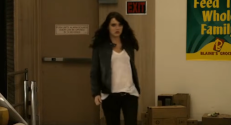
GM: Great, you're looking around the store, scanning the aisles for any sign of your prized Twinkie, when you hear a voice. You turn to see a young woman, black leather jacket, white v-neck, and combat boots come out of the back. "Help! Come quick!" She says with remorse.
Jesse: Does she seem like she's being honest?
GM: Give me personality, -1 for the penalty from before.
Jesse rolls 2d6 - 1 = 5
GM: She's beautiful and dangerous looking. You're smitten.
Fight Review
This scene highlights a few of the idiosyncrasies of Super Dead a bit better than our generic scene before. We don't really get any of the super aspects to it, but I chose it because of how it highlighted:
- the stress mechanic (a reason to hunt for Twinkies)
- the scavenge procedure
- the noise mechanic (playing the banjo)
- the three-exchange hand-to-hand system
- the PbtA-style consequence system (fleeing hand-to-hand)
I also think it highlights one of our design goals: having zombies be both a minor threat in small numbers, and a massive threat in large groups. Here, as three individual zombies, an athletic human is able to pick them all off without much trouble. If they grouped up, all those attacks would be at minus 2, and the attacks with the odd weapons (banjo, sheers) wouldn't have been enough to behead the zombies. Even with just one more zombie, Tallahassee would likely have been cooked.
All in all, super fun little exercise. Please go and read the others who have participated as well: